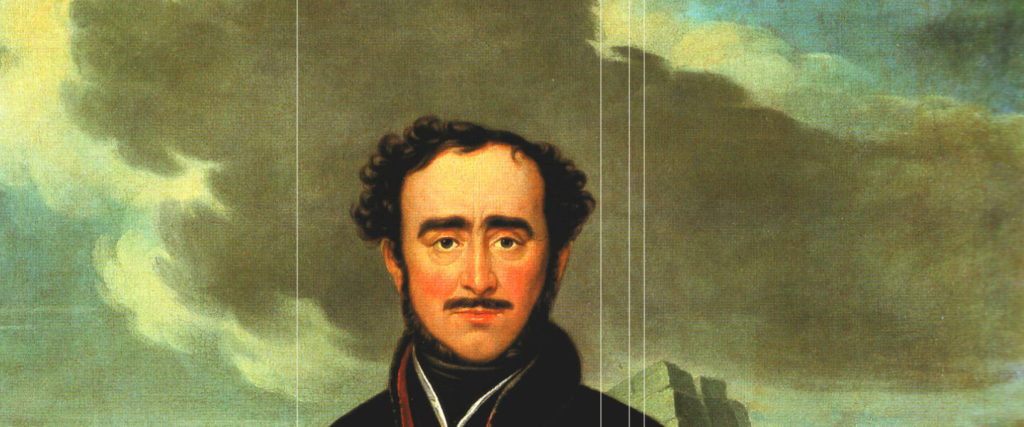
István Széchenyi was already honoured by his contemporaries with the title “the greatest Hungarian”. His work for the creation of modern Hungary is still revered in national memory. His theoretical works played a prominent role in the development of the liberal reform movement, and his lasting practical works served to create a modern citizen nation and to establish the mechanisms of the capitalist market economy.
István Széchenyi was born in a historical period in 1791. The decades of his life, which ended in 1860, are described by Hungarian historiography as the period of transition from the feudal estate system to a civil society based on equal rights and freedoms. Széchenyi was one of the main protagonists of this transition as the most influential initiator of economic, social and cultural modernisation. His activities were far from being limited to giving programmes or playing a political role. Among the results of his multifaceted practical work are those that still exist today, fulfilling their original function: the Hungarian Academy of Sciences is still the central institution of Hungarian science, and the Chain Bridge is the visual symbol of Budapest. In other areas, such as river control, Danube steam navigation, the construction of the railway network or the establishment of certain industries (milling, sugar), he made a significant contribution by taking the first steps. He was also instrumental in raising the standard of horse breeding, in the establishment of social institutions (casinos) and in the modernisation of sporting activities. Many of his practical creations also played an important role in laying the foundations for Budapest's later dynamic urban development. István Széchenyi is an iconic figure of Hungary's modernisation, but he is not a lone hero: the change of regime in 1848 was the collective achievement of a generation. His correspondence is also of unparalleled value in understanding this achievement.