
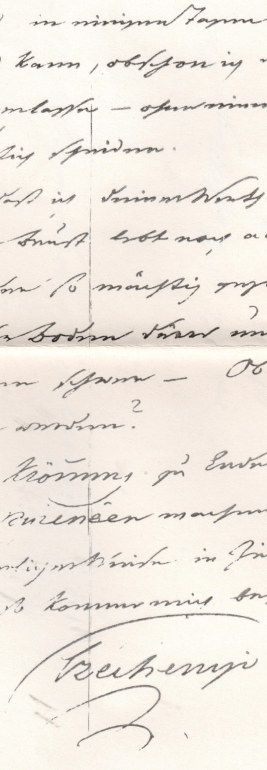
1: He was surprised at the Prince’s rudeness to him on his way out of the theatre. This event makes him stay until he gets satisfaction for his insult.
2: He challenges the recipient to a duel because of his impertinent behavior. He has even postponed his morning journey to settle this disagreement. Simultaneously, he assures the Prince of his high regard.
1.[1] Monsieur,[a] j’ai été extrêmement étonné des vos manières peu polis et prevenantes avec les quelles vous m’avez acceulli hier sortant du Theater, après que je vous ai salué et adressé la parole avec toute la politesse possible
J’avois le projet de partir aujourd’hui – vous me faites rester ‒ et je ne partirai jamais, je vous assure, avant que d’avoir eu toute la satisfaction et réparation d’honneur que vous me devez –— ou avant de m’avoir vengé de votre impolitesse. — J’attend votre reponse ou rendez-vous. – —
2. Monsieur le duc. Après la manière insolente avec le quelle vous m’avez quitté hier, il ne me reste que de vous proposer le choix des armes, du lieu, et de l‘heure qui vous conviendra, car il m’est impossible de croire que vous puissiez avoir eu autre intention que celle de me chercher querelle. Comme je suis aussi peu habitué a me soustraire a pareille rencontre qu’a la rechercher j’ai differé mon depart qui était fixé pour ce matin, afin de terminer ce différent.
Je crois qu’il est inutile de perdre encor du temps en paroles, et que nous ne pourrons faire autrement que de nous depécher autant que possible.
Je saisi cette ocasion pour vous donner l’assurance de ma plus haute consideration. —[b]
[1] Two versions of the letter have survived, the first written by Széchenyi himself, the second by Major D’Aspre Constantin. Széchenyi probably sent the second version to the addressee.
[a] On their way out of the theatre, Duke Avalos of Naples and his wife Hortenzia bumped into Széchenyi and his spirited friends, who were desperate to make Széchenyi and the princess acquaintances. Duke Avalos, without a word to the young men, led his wife to his carriage and drove home. Széchenyi was seriously preparing for the duel, but when the duke came to see him the next day, he abandoned his increasingly ridiculous plans. For more on this see SzIN 1. 112–115.
[b] According to his letter of 21 May 1815, he arrived in Naples the previous day, but according to his diary entries, on the 22nd. See his letter to his father of 21 May 1815 and his diary: SzIN 1. 112.
Recommended reference:
István Széchenyi to Prince Avalos, Naples, 25 May 1815. Edited and annotated by Szilvia Czinege. Published in Correspondence of István Széchenyi. Digital edition. Edited by Szilvia Czinege and Zoltán Fónagy. https://szechenyilevelezes.abtk.hu/ Abbreviation for further references: SzIL-Digit.