
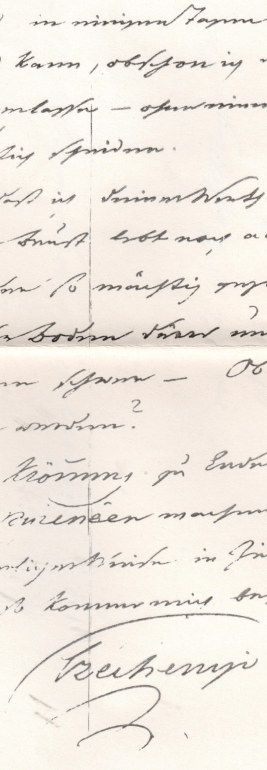
Schwarzenberg and Metternich are so busy you can hardly get in to see them. He was received graciously; there was no question of promotion, the Emperor even refused to appoint lieutenants. Schwarzenberg’s camp will be disbanded with the Dijon operation, and he is leaving for England in a few days’ time in the company of Moritz Woyna. Woyna has to present a grenadier and an ulan to the Prince Regent. He will ask Radetzky for the regiment’s roster of officers and at the same time introduce himself to the British owner of his regiment. Not knowing how long he will remain in England, or what he will do when he returns, his only ambition is find his feet and serve his country in every situation. He will probably not stay abroad for long, as he has already spent too much. He asks that letters to him be addressed to Messrs Perregaux and Laffitte in Paris.
Geschrieben in Paris den 21. Sep. 1815[1]
Mein lieber guter Vater, endlich habe ich glücklich alle meine Besuche geendigt — bei Gott eine sehr schwere Aufgabe — Schwarzenberg[a] – Metternich,[b] sind so beschäftiget – und so sehr besucht – daß man sich ganz glücklich schätzen kann, wenn man nach mehrmaligen Versuchen – bei ihnen vorkommen kann — Sie waren recht gnädig — das ist alles was ich sagen kann von avancieren ist gar keine Idee – der Kayser schlägt sogar lieutenants-stellen ab – und somit Geduld und Rittmeister.[c] Da nun aber Schwarzenbergs ganze suite nach dem enuenten manoeuvre in Dijon[d] auseinander gehen wird – und ich wie ein Narr auch nicht zum Regiment einrücken will — da mich diese miserabilität anekelt — so bath ich Schwarzenberg mir einen Urlaub zu geben — und gehe hiemit en titre de Voyageur[2] in einigen Tagen mit Moritz Woyna[e] nach England – er hat auch beinahe eine eben so rühmliche Ursache nach der Insel zu segeln wie ich – er bringt einen Grenadier und einen Uhlanen zu Prinz Regenten,[f] um sie vorzustellen. ~ ich hab‘ das project diese Kerl’s um’s Geld daselbst ansehen zu lassen – – übrigens nehme ich von Radetzkӱ[g] die Tabelle des Regiments mit — und besuch ganz einfach meinen brittischen proprietair[3] – – Wie lang ich dan da bleiben werde, das weis[4] ich gar nicht — und was dan mit mir geschieht – das ahnde ich gar nicht — und so lebe ich ganz allein in der Tendenz fort — mich in jeden Fach geschickt zu machen – meinem Vaterlande dienen zu können — Will das Glück mir nicht gut — so bin ich doch mit meinem Gewißen, und mit meinem höchsten Richter versöhnt — und kann dan ruhig die Fortuna an mir vorbei ziehen sehen.
Sehr lang werde ich vermuthlich nicht ausbleibe[n, – da ich][5] bis jetzt schon sehr viel Geld ausgegeben [habe und–]5 der Article mir dan sehr bald fehlen dürfte. Von der Theurung macht man sich gar keinen Begriff da sich wirklich das ganze Geschlecht der Menschen wie ein Babel angehäuft hat.
Meiner lieben guten Mutter versprochene Tasse übersende ich hiemit ~ und küß tausendmal die Hände. Steph.
Ich bitte immerfort die Briefe an Messieurs Perregaux Laffitte[h] nach Paris adressiren zu wollen.[6]
[1] Széchenyi’s underlining with wavy line.
[2] Francia: as a traveller.
[3] Francia: owner.
[4] Instead of weiß.
[5] Part of the text is not visible due to the stamp.
[6] At the top of the second page, written upside down and underlined with a thick wavy line.
[a] Prince Karl Schwarzenberg (1771–1820) field marshal.
[b] Prince Klemens Wenzel Lothar von Metternich (1773–1859) was an Austrian statesman, Foreign Minister of Austria from 1809, chancellor of state (1821–1848) and a leading figure in Austrian politics.
[c] He asked to be promoted to Major during our respectful visits to Schwarzenberg and Metternich, but he was advised to be patient.
[d] At the time of the decisive defeat of the French at Waterloo, the Austrian army was at Dijon.
[e] Count Moritz Woyna (1788–1850) was a colonel in the 4th Uhlan Regiment, but was a major at that time.
[f] George Augustus Frederick, Prince of Hanover (1762–1830), heir to the English throne, King of England as George IV (1820–1830). Széchenyi named him Prince Regent because he exercised the rights of monarch as regent from 1810 in place of his father George III (1738–1820, King of Great Britain and Ireland: 1760–1820). The English regent held the rank of Austrian field marshal and was a Knight of the Order of the Golden Fleece, furthermore, he was the owner of the 5th Hussars Regiment.
[g] Count Joseph Wenzel Radetzky (1766–1858), lieutenant general, after the Battle of Aspern he became commander of the 4th Corps. He was the co-owner of the 5th Hussars Regiment.
[h] Jacques Laffitte (1767–1844) was a French banker and politician, Perrégaux’s banking partner and successor after his death.
Recommended reference:
István Széchenyi to Ferenc Széchényi, Paris, 21 September 1815. Edited and annotated by Szilvia Czinege. Published in Correspondence of István Széchenyi. Digital edition. Edited by Szilvia Czinege and Zoltán Fónagy. https://szechenyilevelezes.abtk.hu/ Abbreviation for further references: SzIL-Digit.