
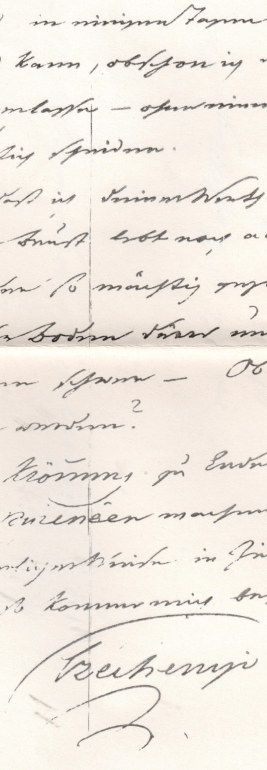
Does he think that he is depriving Széchenyi of all hope by leading to the altar the unloved bride whom he himself adored for so long? He asks him to renounce Henriett; he can only call her his bride when Széchenyi is no longer alive. He counts on his discretion.
Glauben Sie,[a] daß Sie alle Hoffnungen meines Lebens mir rauben, die Liebe die ich in meinen Herzen glühen fühle damit allein zertreten werden, daß Sie sich zeigen, und mit Kalter Hand eine ungeliebte Braut zum Altar führen, die ich so lange schon anbethe –
Leisten Sie, ich bitte Sie um Gottes Willen, Verzicht auf H[b] – Besitz; denn sie können[1] bey Allem was Heilig ist[2] dann erst ihre Braut sie nennen, wen[3] ich nicht mehr bin, und sie über meinen Leichnahm geschritten sind – –[c] Ich bin sicher an einem Manne von Ehre zu schreiben – und zähle auf Ihre Verschwiegenheit.
[1] Interlining afterwards.
[2] One word deleted by Széchenyi.
[3] Instead of wenn.
[a] Prince Adolf Schwarzenberg (1799–1888), nephew of Field Marshal Prince Karl Schwarzenberg (1771–1820).
[b] Princess Henriett of Liechtenstein (1806–1886) later became the wife of Count József Hunyady (1801–1869). For more on Széchenyi’s love for Henriett of Liechtenstein: SzIN 2. XLI–LXI.
[c] Széchenyi kept track of who and when the prince was courting. SzIN 2. 334., 349., 396, 435. The prince eventually married Princess Eleonora Liechtenstein (1812–1873) in 1830. SzIN 2. 334. footnote 4.
Recommended reference:
István Széchenyi to Adolf Schwarzenberg, Vienna, 29 December 1823. Edited and annotated by Szilvia Czinege. Published in Correspondence of István Széchenyi. Digital edition. Edited by Szilvia Czinege and Zoltán Fónagy. https://szechenyilevelezes.abtk.hu/ Abbreviation for further references: SzIL-Digit.