
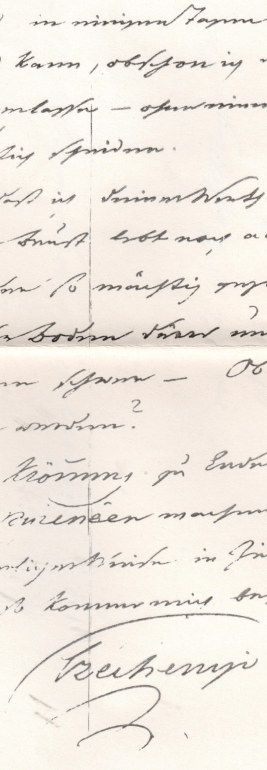
It is impossible to decide whether war or peace will follow. The armistice has been declared, the Prague Congress has been called. 9-10 days ago, General Kutsera travelled to Buda to see the palatine in order to organise the Hungarian noble insurrection with the greatest haste. The vacant officer posts in the army are also being filled one by one. Two first lieutenants have already been promoted to the rank of captain among the Merveldt lancers, and he was the second candidate in the ranking for the captaincy, which he has good prospects of obtaining, as many company commanders have recently left them. The Prince, his superiors and his comrades like him, and he is pleased. They often go to Prague, but life there is now infinitely bleak, and there is no one to visit except Countess Klebelsberg. The days are pleasant in Lieben. In the mornings everyone goes on duty, in the evenings they play music or whist. His brother-in-law is well, he is stationed with his regiment at Bömisch-Leipa, and is now the actual regimental commander, and Klebelsberg is taking baths at Teplitz. He has not heard anything from Nesselroder, and has already written to Lieutenant General Wallmoden, with whom he is supposed to be staying, to find out something about him.
Geschrieben in Lieben[a] den 11 Julÿ 1813[1]
Euer Gnaden, Liebster Bester Vater!
Je mehr die Zeit der Entscheidung naht, desto räthselhafter scheint die Zukunft vor unsern Augen zu liegen, doch in wenigen Wochen wird man das gewiß wissen, was man jetzt zu erforschen vergebens trachten würde. — Sonderbar ist es, man muß es gestehen, daß man beynahe gar nicht combiniren kann ob den Krieg[b] – ob Friede von dem Schicksal der Zeit uns bestimmt sey. Ich weiß gar nichts, und sehe eben so viele preparativen des kriegerischen Lebens — als friedliche Operationen.1[c]
Der Waffenstillstand ist denn endlich prolongirt, der Congress in Prag entschieden. Schon ist Narbonne[d] da – und fährt morgen nach Brandeis[e] zum Käyser[f] wo er sich einige Täge wahr aufhalten wird – Sonst ist noch gar kein Abgesandter in Prag angekommen. — General Kutsera1[g] ist vor 9 oder 10 Tagen nach Ofen zum Palatin, um die ungarische adeliche Insurrection in der größten Geschwindigkeit zu organisiren – Die Landwehr wird mit Macht errichtet – und ihre Stabsoficiers gewählt.[h] — Auch sind alle Chargen in der Armee ersetzt – Bey Merveld-Uhlanen sind bereits 2 Oberlieutenants zu[2] Rittmeisters avancirt – ich bin nun der 2te zum Rittmeister – und da eben so viele Escadrons commandanten wechkommen[3] werden, so hoffe ich in sehr geringer Zeit zu avanciren — Dieß alles wäre also Kenntzeichen des kriegerischen Lebens – ~ Nach meiner Beurtheilung ist aber alles dieß zum Scheine nur[4] und nach dem alten Sprichwort der Römer „Si vis pacem para bellum1,[5] – Die Folge wird’s wohl bald zeigen.
Fürst Schwarzenberg ist nun seit einigen Tagen immer hier, Die Fürstin seine Frau[i] ~ war auch da – ist aber wieder bereits zu sich nach Worlik[6][j] zuruck. ~ Ich befinde mich übrigens recht gut, und wohne – eine halbe Stunde von Prag1 – und eben so viel – von Lieben6 in einen einschichtigen Haus, in der schönsten Gegend die man sich nur immer denken kann – en Compagnie von jungen Lichnowskÿ[k] — und den Grafen Schulenburg[l] — Meine Pferde befinden sich alle in besten Zustand – wie auch meine Leute, ich selbst auch — Der Fürst[m] hat überaus viele Gnaden für mich — wie auch meine Vorgesetzten — und meine Kameraden recht viele Freundschaft — und so bin ich so zufrieden — wie man’s nur immer seyn kann. —
Wir gehen recht oft nach Prag – wo’s aber unendlich ennuent[7] ist — und auser der Gräfin Klebelsberg[n] beynahe kein Mensch da.
Lieben ist aber ganz allerliebst und gleicht einer Colonie — da jeder so zu sagen ein kleines Shlößel für sich bewohnt was von denen übrigen blos durch kleine Wälder, Gärten oder Thäler getheilt wird — In der Früh geht jeder seinen Dienst nach – der für den Augenblick ganz unbedeutend ist — zu Mittag – ist natürlicher = Weise1 ein sehr ein angenehmes rendez-vous — ‒ den[8] was so ein Galopin für einen Hunger hat, davon macht keine Seele einen Begriff — Nachmittag ist meistens Musik6 und auch oft eine Parthie Vist6[o] – und so – vergeht mir ein Nachmittag nach den andern – eben so angenehm, wie der Morgen – Blos mit den soupée da ist das Schicksal grausam — und die Vorsicht schuf für uns kein hôtel — mais il faut faire bonne mine ā movais jeu[9] – und so habe ich mir das soupiren — als eine sehr üble Gewohnheit — und aus einer Philosophie — durch die Nothwendigkeit – verschönert —— ganz tapfer abgewöhnt.
Von meinen ehmaligen Obristlieutenant[p] habe ich Nachricht – und er befindet sich recht gut – er steht mit seinem Regiment in Böhmisch-Laipa6[q] und ist Brigadir zu gleich — da der Klebelsberg in Töplitz[r] das Bad braucht.
Von Nesselrode[s] höre ich gar nichts; und schrieb an F. M. L.[10] Walmoden[t] bey den er seyn soll, um etwas von ihm zu erfahren — Wie mich aber diese Ungewißheit kränkt – ob er lebe – oder schon in der Eweigkeit sey – können sich Euer Gnaden, Lieber Vater, wohl denken — Es ist wohl vieleicht. der einzige Freund den ich auf dieser Welt hatte – ‒ doch ist alles so Vergänglich daß man auf das Vergangene mit Schaudern nur denken kann —
Ich küsse die Hände nun Lieber Vater – auch die meiner theuern Mutter — und Bitte um den Segen
Euer Gnaden
dankbarster Sohn Stepherl
[1] Széchenyi’s underlining with wavy line.
[2] Corrected word.
[3] Instead of wegkommen.
[4] Inserted afterwards.
[5] Latin: „If you want peace, prepare for war.” The phrase is adapted from the Roman author Flavius Vegetius Renatus’s opus Dē Rē Mīlitārī.
[6] Széchenyi’s underlining with straight line.
[7] French: boring.
[8] Instead of denn.
[9] French: but you have to put on a brave face.
[10] Feldmarschalllieutenant
[a] Lieben is a Bohemian village at the confluence of the Rokytnice stream and the Vltava River.
[b] Napoleon defeated the Russo-Prussian army at Grossgörschen on 2 May 1813 and at Bautzen on 20 May 1813, forcing it to retreat. Meanwhile, Austria had set up an army of observation in Bohemia, and Field Marshal Prince Karl Schwarzenberg was appointed commander-in-chief of this army. At the request of Ferenc Széchényi, the War Council appointed István Széchenyi, Lieutenant of the 1st Merveldt Lancer Regiment, as a commanding officer in the general staff of the general commander by decree of 20 May. Széchenyi reported for duty in June.
[c] The belligerent armies (i.e. the victorious French and the defeated Russo-Prussian) were exhausted and in need of resupply. At Austria’s suggestion, an armistice was concluded at Pläswitz on 4 June until 20 July. Austria, however, concluded a treaty with France on 30 June, committing itself to mediate peace. Napoleon accepted it. It was agreed that the Russian, Prussian, French and Austrian plenipotentiaries would meet at the Congress of Prague on 5 July to negotiate a peace proposal, and the armistice was extended until 10 August, with six days’ notice. The Congress of Prague did not meet until 12 July, but the peace terms were not negotiated. Austria communicated the peace terms to Napoleon before the deadline, but having received no reply by the deadline (10 August), it joined the alliance and declared war on France.
[d] Louis de Narbonne-Lara comte (1755–1813), French general and politician, commander of the occupied Győr in 1809, at the time he was dispatched by Napoleon to the Congress of Prague. In 1813, as Commander of Torgau, he died of typhus.
[e] Czech town on the Elbe, east of Prague.
[f] Francis I (1768–1835), Emperor of Austria and King of Hungary (1792–1835).
[g] Baron János Kutsera (1765–1832) was the Emperor’s chief aide-de-camp, general.
[h] The Landwehr was the territorial militia of the Austrian provinces. There was no noble insurrection in Hungary after 1809.
[i] Field Marshal Prince Karl Schwarzenberg, appointed commander-in-chief of the allied armies, and his wife, Count Mária Anna Hohenfeld (formerly the widow of Prince Antal Pál Esterházy).
[j] A village on the Morava River in Bohemia with the castle of Prince Karl Schwarzenberg.
[k] Count Vilmos Károly Lichnowsky (1793–1864), lieutenant, commanding officer.
[l] Count Károly Rezső Schulenburg-Vitzenburg (1788– after 1852), major, one of the aides-de-camp of Prince Karl Schwarzenberg.
[m] I. e. Prince Schwarzenberg.
[n] Count János Klebelsberg (1772–1841) general since 1809, lieutenant general since 1813, married to Count Anna Pejacsevich (1785–1847).
[o] Whist card game.
[p] His brother-in-law, Count Ferdinánd Zichy (1783–1869) was at the time the commander of the 7th Hussar Regiment, and he was his deputy brigade commander.
[q] Böhmisch Leipa (Česká Lípa) is a town near Polenz, in the north of Bohemia, near Tetschen (Děčín).
[r] Teplice is a town in the Biela Valley, where Austria, Prussia and Russia forged the Triple Alliance against Napoleon on 9 September 1813.
[s] It cannot be determined which Nesselrode was that. According to his letter of 18 August 1813, he was a captain assigned to the general staff of the commander of the Russian-German legion. Previously, he was obviously in Austrian service with Széchenyi in the same regiment.
[t] Count Ludwig Wallmoden-Gimborn (1769–1862) took part in the French wars, and in 1812 he briefly entered Russian service and became commander of the Russian-German Legion. In 1815 he was again in Austrian service and stationed in Italy. In 1838 he became a general of cavalry, in 1848 deputy to Radetzky.
Recommended reference:
István Széchenyi to Ferenc Széchényi, Lieben, 11. July 1813. Edited and annotated by Szilvia Czinege. Published in Correspondence of István Széchenyi. Digital edition. Edited by Szilvia Czinege and Zoltán Fónagy. https://szechenyilevelezes.abtk.hu/ Abbreviation for further references: SzIL-Digit.