
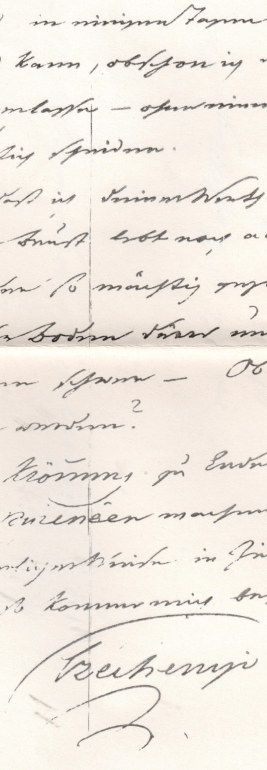
The great danger has passed, and he has blissfully withstood the test. Now they’re always going forward. The battle was lucky for him if only because all the members of the general staff had been promoted one rank, and he was now first captain. He leaves immediately for Jena, but he wanted to show sign of life before that.
Geschrieben in Nauenburg[1][a] den 22 8ber
1813
Lieber Vater, Gottlob, viele Gefahren sind vorüber, und auch diese Probe der Vorsicht hielt ich glücklich und froh aus.[b] ~~ Nun gehts immer vorwärts — auch habe ich in hinsicht meiner Person eine glückliche Schlacht gehabt da mir nichts geschah, und die ganze suite um einen Grad avancirte folglich ich nun 1ster Rittmeister bin.
Alsogleich gehe ich nun nach Jena[c] und habe meinen guten Eltern nur ein Zeichen meines Lebens geben wollen: der ich um den Segen bitte
Stepherl
[1] Széchenyi’s underlining with wavy line.
[a] Naumburg, a Saxon town southwest of Leipzig, on the river Saale. (Nauenburg, as Széchenyi wrote, has existed only since 1862, as a suburb of the municipality of Heere in the state of Lower Saxony, northwest of Leipzig.)
[b] By that, he means the Battle of Leipzig of 16–19 October. On the first day of the battle, he was in close combat when he took part in the cavalry charge at Güldengosse.
[c] Jena, a Saxon town on the banks of the Saale, south of Naumburg. After the lost battle, Napoleon retreated with most of his army along the Weissenfeld-Frankfurt route towards France. The allied armies were in pursuit, lined up on both sides of the route: the Silesian army (Blücher) on the right, the main army (Schwarzenberg) on the left, marching in three columns.
Recommended reference:
István Széchenyi to Ferenc Széchényi, Naumburg, 22 October 1813. Edited and annotated by Szilvia Czinege. Published in Correspondence of István Széchenyi. Digital edition. Edited by Szilvia Czinege and Zoltán Fónagy. https://szechenyilevelezes.abtk.hu/ Abbreviation for further references: SzIL-Digit.