
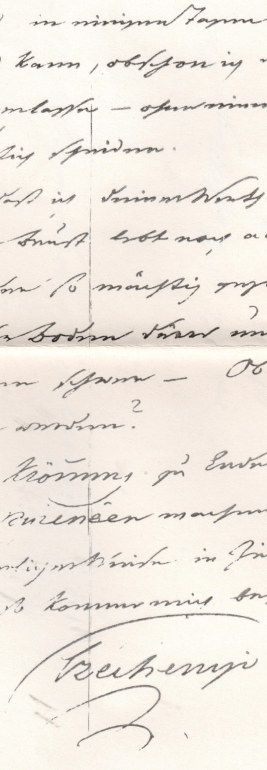
This case has also been resolved happily. Schwarzenberg did not accept Dresden’s surrender terms. The frontier between Freiburg and Schaffhausen was unguarded, so the Field Marshal sent him here, confident that no one would get through his section of the frontier. He is travelling on to Strassburg.
Geschrieben um 2 Uhr in der Früh in Engen:[a] 2 Posten von Schafhausen.[1]
Auch dieses Geschäft glücklich abgethan.1 Wie Euer Gnaden wissen hat der fürst Schwarzenberg[b] die Capitulation von Dresden nicht angenommen, sondern machte denen Franzosen die Beyden Bedingniße — oder[2] „wieder in der Stadt Posto1[c] zu fassen oder sich ohne Aufschub zu ergeben; da sind den[3] mehrere franzöische Generäle gewesen, die von Beyden keines hören wollten, sondern sich über die Gränze zu flüchten glaubten.[d] Nun war zum Unglück die Gränze von Freyburg an bis Schafhausen unbesetzt – so hatte der Feldmarschall das Zutrauen zu mir mich dahin zu schicken – der ich bis jetzt, Gottlob, eine Art von Landmilitz1 zuwegen gebracht habe und ganz gewiß bin, daß kein Mensch bey mir durchkommen werde. — Ich wollte meinen guten lieben Eltern nur ein Zeichen des Lebens geben wollen – da ich nicht weiß wo ich anjetzt das Hauptquartier mehr finden werde und in dieser minutte wieder gegen Strassburg abreise.
Den Segen bittend bleibe ich
Meinen guten Eltern
dankbarster Sohn Stepherl
[1] Széchenyi’s underlining with wavy line.
[2] Instead of entweder.
[3] Instead of denn.
[a] A town in southern Germany, in the state of Baden-Württemberg, near the French and Swiss borders.
[b] Prince Karl Schwarzenberg (1771–1820) Austrian field marshal.
[c] A town in Baden, north of Schaffhausen.
[d] Dresden was besieged by the Austrians after their advance, with only 15 thousand men and 60 cannons. Under the command of General Count Klenau, the number of besiegers soon increased to 45,000 and 125 guns. The besieged French army suffered much from hunger, so they tried to drive the civilians out of the city and then break out towards Torgau. The breakout failed, and on 11 November the French surrendered on the condition that they would be allowed to leave for France as prisoners of war, with French General Saint Cyr guaranteeing that they would not fight the Allies until the final exchange. Schwarzenberg did not approve of this agreement and ordered Klenau to demand either unconditional surrender from the French or to return to Dresden and continue the fight. The French army, however, was already on its way home. At this news they scattered and tried to escape home across the border. Schwarzenberg and Schulenburg tried to prevent this through their aide-de-camp. Klenau was investigated after the war but was acquitted on the grounds that Schwarzenberg’s instructions were not clear enough. Széchenyi’s notes add to the war conclusions. The captured Frenchmen were transported to Austria.
Recommended reference:
István Széchenyi to Ferenc Széchényi, Engen, 30 November 1813. Edited and annotated by Szilvia Czinege. Published in Correspondence of István Széchenyi. Digital edition. Edited by Szilvia Czinege and Zoltán Fónagy. https://szechenyilevelezes.abtk.hu/ Abbreviation for further references: SzIL-Digit.