
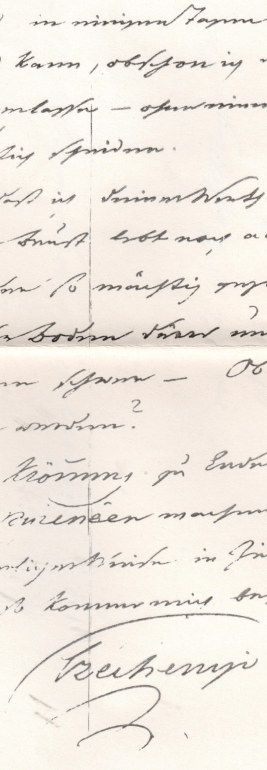
After writing the letter, he and his friend Trogoff left for Altkirch, where headquarters followed them the next day. He is convinced that they can get to Besancon without a serious fight, but that they can expect stiff resistance there. Two days ago he had the great pleasure of seeing his friend Nesselrode again, but the meeting was short-lived as he had to travel on to Count Wittgenstein’s headquarters.
Geschrieben den 1 Jäner 1813[1] in Basel[2]
In diesen Augenblick werde ich mit meinen Freund Trogoff[3][a] der meinen hiesigen Aufenthalt am meisten verschönert hat. über die Grenze Frankreich’s nach Altkirch3[b] gehen:[4] morgen in aller Früh geht das ganze Hauptquartier nach. —
Ich bin überzeugt daß wir wenigstens bis B[esancon][5] vordringen werden ohne eine tüchtige Affaire [zu haben, da] aber giebts gewiß einen hartnäckigen Kampf, den zu gewinnen unsere Hoffnung und beynahe gewißheit ist.[c]
Wir haben Hünningen2 nun seit 8 Tagen stets beschoßen und da habe ich beynahe immer, wenn ich einen freӱen Augenblick hatte, mich beym Generalen Pappenheim2[d] aufgehalten, von den seiner Wohnung jede Bombe3 jede Granate3 ganz superbe sichtbar war — auch wird sich das infame Nest wohl noch ziemlich lange halten – unsere Operationen aber keinesweges verhindern.
Vor zwey Tagen, stellen sich Euer Gnaden vor, welche ungemeine Freude hatte ich? ich sah meinen alten Nesselrode[e] der zu uns als Courir aus Bremen[f] kamm,[6] und von den ich die ganze Campagne hindurch beynahe nichts ge[wißes] wußte – nun war das Vergnügen allzukurz da ich in [das Haupt]quartier des Grafen Wittgenstein3[g] abreisen mußte. Gott weiß wenn[7] ich ihm anjetzo wieder finden werde. —
Von Altkirch2 oder Kolmár3[h] werde ich Euer Gnaden noch heute oder morgen schreiben. jetzt kann mein guter Trogoff auf mich nimmermehr warten.
Meiner Lieben Mutter küsse ich die Hände und bitte um den Segen.
Stephan
[1] Instead of 1814.
[2] Széchenyi’s underlining with wavy line.
[3] Széchenyi’s underlining with straight line.
[4] Inserted afterwards.
[5] The manuscript is damaged due to the seal, and the missing words are partly visible on the seal and partly inferable. The missing text is marked with square brackets.
[6] Instead of kam.
[7] Instead of wann.
[a] Joachim Simon Louis de Trogoff (1762–1840) was a royal French nobleman who returned to France from service in Austria.
[b] Upper Alsace town on the Ill River, between Basel and Belfort.
[c] See the letter written on 20 December 1813.
[d] Count Karl Theodor von Pappenheim (1771–1853) Austrian general, from 1809 general of the Royal Bavarian Army.
[e] His identity cannot be established exactly, he was probably a fellow officer of Széchenyi in the 1st Lancer Regiment. In 1814, he was a captain in the Russian Legion in the retinue of Lieutenant General Wallmoden. See also the letters of 11 July, 15, 18 August and 3 September 1813.
[f] A northern German port town on the Wesel estuary, it belonged to France between 1810–1815.
[g] Count Adolf Peter Wittgenstein (1769–1843) Russian general of cavalry, commander-in-chief of Russian troops belonging to the allied forces during the campaign of 1813–14.
[h] A town in Upper Alsace on the Lauch River.
Recommended reference:
István Széchenyi to Ferenc Széchényi, Basel, 1 January 1814. Edited and annotated by Szilvia Czinege. Published in Correspondence of István Széchenyi. Digital edition. Edited by Szilvia Czinege and Zoltán Fónagy. https://szechenyilevelezes.abtk.hu/ Abbreviation for further references: SzIL-Digit.