
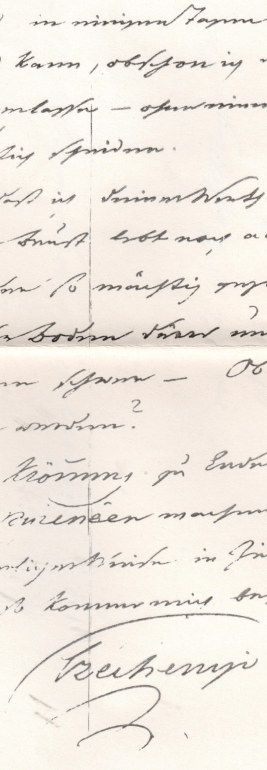
He has been fox hunting for 3 weeks now, which he considers a success. Counts Mihály and Vince Esterházy are with him, and the next day more guests arrive.
23ten März 1824 Zinkendorf
Lieber Wesselenyi, Seit 3 Wochen sitze ich hier nur Meister Reinecke[1][a] zu jagen,[b] was im Anfang, da die Piste[c] noch besser war, mit gutem Succes gieng. We had several very good runs.
Alles was in Wien Anspruch auf high and fashionable breeding macht, war in meiner anspruchslosen Behausung. In diesem Augenblick ist Miska Esterhazy[d] hier, den ich immer mehr gerne und lieb gewinne, je mehr ich ihn kenne.
In diesem Augenblick ist W. Liechtenstein, V. Esterhazy,[e] Miska Esterh.d hier. Morgen kommen die 2 Parish.[f] Leikam.[g] Louis und Franz Liechtestein.[h] Gr.[2] Erdödy.[i] Es ist Alles im Gang.
Ich empfehle mich deinem Andenken und deiner Freundschaft.
Manchester[j] ist das beste Pferd auf dem Platz.
Széchenyi
Ich empfehle mich Deiner Mutter mit aller Ehrfurcht.
Vidi M Esterházy, der Dir vor ein paar Tagen geantwortet hat, sich hier sehr gut unterhält, und Szechenyi Gleiches mit Gleichem vergielt. –
Mit Vergnügen erinnert sich Vincenz Esterházy, welcher eben auch hier ist seines Freundes Vesselenyi, und hoffet in Herbst wieder Sie auf den Jagden zu sehen. – Der junge Hund ist auf der Welt, und soll zu ihren Diensten gut werden ——[3]
[1] Széchenyi’s underlining with straight line.
[2] Graf
[3] The section following the signature and postscript was written by the Counts of Esterházy.
[a] ‘Meister Reineke’ is a character from a German folk tale and heroic epic. J. Ch. Gottsched (Reineke der Fuchs) and J. W. Goethe (Reineke Fuchs) also adapted the story of the cunning fox.
[b] I. e. he is on a fox hunt.
[c] The mark or scratch made by the game.
[d] Count Mihály Esterházy (1794–1866), a fellow soldier and friend of Széchenyi, and owner of the Tallós estate in Pozsony County.
[e] Count Vince Esterházy (1781–1835), a hussar colonel and later a general, was a friend and cousin of Széchenyi.
[f] David Parish (1778–1826) was a German and American merchant, financier and entrepreneur who provided financial assistance to Austria during the Napoleonic Wars and the Italian conflict of 1819. He was on good terms with Metternich, under whose influence he settled permanently in Vienna. For his services during the Napoleonic Wars, he was made a baronet in Austria under the name of Senftenberg.
[g] Baron Cristoph Ambros Leykam (1777–1830) was an Austrian diplomat.
[h] Prince Ferenc Liechtenstein (1802–1887), son of Prince János Liechtenstein and one of the two Princes Alajos Liechtenstein (the lieutenant general, 1780–1833, or the other Prince, 1796–1858).
[i] Probably Count Kajetán Erdődy (1795–1856).
[j] Széchenyi’s horse.
Recommended reference:
István Széchenyi to Miklós Wesselényi, Vienna, 23 March 1824. Edited and annotated by Szilvia Czinege. Published in Correspondence of István Széchenyi. Digital edition. Edited by Szilvia Czinege and Zoltán Fónagy. https://szechenyilevelezes.abtk.hu/ Abbreviation for further references: SzIL-Digit.