
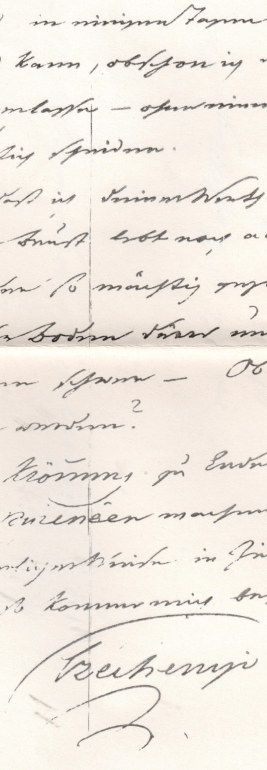
Do they have a lot of money? Did Sophie get the 600 # from Tarutmannsdorf? How much wool do they have? He didn’t spend much, and he won’t, either. He is well; he’s due back in August.
Ihren Brief vom 1 Junӱ[a] habe ich bekommen, und werde im Sinn Ihres Schreibens meinem Bruder Louis antworten, im Fall er sich an mich wenden sollte.
Haben wir viel Geld?
Hat Sophie[b] die 600 # von Trautmannsdorf[c] eincassirt?[d]
Wie viel Wolle haben wir?
Ich habe nicht viel Geld ausgegeben, und werde auch nicht viel ausgeben.
Mir geht es gut, und ich gedenke im August zurück zu seӱn.[e]
Adieu
Széchenyi
Paris 14 Junӱ[f]
Lassen Sie den Weg nach Kreutz[g] machen!
[a] The letter is unknown.
[b] Her sister, Countess Zsófia Széchényi (1788–1865), was the wife of Count Ferdinánd Zichy (1783–1862).
[c] Count János Trautmannsdorf–Weinsberg (1780–1834), Austrian master of the horse.
[d] On 9 May 1825, Széchenyi sold his horse Pardenic for 600 gold pieces. See also the letter of 9 May 1825.
[e] He only arrived home on 9 September. SzIN 2. 602.
[f] The letter was written in 1825 based on its content. He was in France at the time, accompanying Prince Pál Esterházy as chamberlain to the coronation of Charles X.
[g] Németkeresztúr in Sopron County, now known as Deutschkreutz in the Austrian province Burgenland.
Recommended reference:
István Széchenyi to János Liebenberg, Paris, 14 June 1825. Edited and annotated by Szilvia Czinege. Published in Correspondence of István Széchenyi. Digital edition. Edited by Szilvia Czinege and Zoltán Fónagy. https://szechenyilevelezes.abtk.hu/ Abbreviation for further references: SzIL-Digit.