
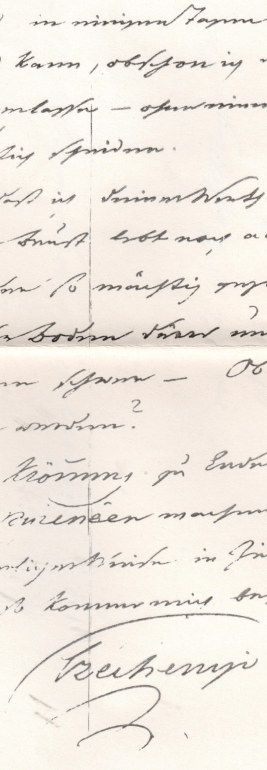
He was almost captured in the battle of Győr. Pál is well, although he was in great danger. He does not know the whereabouts of Lajos, but he is sure that he is all right, because Count Erdődy spoke to him after the battle. He hopes that he has joined General Mesko’s army. Lieutenant Colonel Voith is also there; hopefully they will join forces with viceroy Gyulai’s troops. Their casualties are light; twice as many French as Hungarians were killed in the battle, and their troops are in the best of order. The only reason for the defeat is that the insurrectionists had never been in the firing line before. The retreat was orderly, and they are already reassembled at Komárom, Ferdinand Zichy and Francis are well; he sends Sophia a thousand kisses. Pál adds that they have just learned that Lajos is in good health and is in the outpost at Bicske.
Euer Gnaden, Liebster bester Vater!
Umbewust ob ich Euer Gnaden und die beste Mutter, bald wieder[1] segen[2] werde können, danke ich noch einmahl für alle Gnaden, ich werde immer suchen sie zu verdienen. Mein Bruder Paul ist sehr wohl auf, es ist ihm, obwohl er in großer Gefahr war, gar kein unglück wiederfahren. Ich[3] bin fast gefangen worden,[a] doch bin ich schon wieder sicher. Wo der Bruder Louis ist wissen wir noch nicht, doch ist ihm kein unglück geschehen, inden[4] er nach der Schlacht,[b] noch mit den Grafen Erdödӱ[c] gesprochen hat, es wird hoffentlich zamt seiner ganzen Escadron, und andere 7 tausend[d] Menschen beym General Mesko[e] sich befinden, unter diesen Truppen befindet sich auch der ObristL[5] Voith:[f] sie werden sich hoffentlich mit den Banus Gyulai[g] vereinigen. Unser Schaden den wir von dieser Schlacht haben ist sehr gering. Die Franzosen haben fast zweymahl so viele Manschaft verlohren als wir,[h] und Canonen haben wir nicht eine einzige verlohren, und unsere Truppen sind in der größten Ordnung. Wir hoffen noch den besten Erfolg. die Ursache unseres Verlustes, sind blos, die noch nie in Feuer Gewesenen Insurgenten, deren manche sich doch zum bewundern auszeichneten. Es ist nicht zu verlangen, daß ganz neue organisirte und noch nicht exercirte Truppen, das gröste Granaten und Cartatschen Feuer aushalten sollen, sie retirirten immer aber in guter Ordnung, und wir sind nun wieder in Comorn alle versammelt. Nun bitte ich um den Segen, und bleibe immer
Meines besten Vaters
dankbarster Sohn Stephan
Széchényi
Comorn den 18 Junӱ 1808[i]
Paul’s afterthought:
Der Ferdinand[j] und Franz Zichӱ[k] befinden sich gut. und küssen die Sophie tausendmahl. und ich alle Pesther die mich noch ein wenig lieben.
Eben haben wir erfahren daß der Louis in Bitske[l] gesund auf Forposten[6] stehet.
Paul
[1] Inserted afterwards.
[2] Instead of sehen.
[3] One word deleted.
[4] Instead of indem.
[5] Lieutenant
[6] Instead of Vorposten.
[a] The retreating army of Archduke John, numbering 18,000 infantry and 2,000 cavalry, joined the noble insurrection of about 19,000 men, and on 14 June, in poorly chosen terrain, between Győr and Kismegyer, engaged the French army of about 55,000 men under the command of the Italian Viceroy Eugene Beauharnais. The French won an easy victory, because the poorly armed and trained insurgents, forced into inaction, could not withstand the cannon fire. The main Austrian forces retreated to Komárom, while the 5,000 to 7,000 troops stationed in the ramparts of the fortified Győr camp remained in place for the time being.
[b] The rearguard, standing between the ramparts, was ordered to surrender by the French. General József Meskó immediately called a council of war, and the plan of Lieutenant Colonel Voith to retreat was accepted. That night it was István Széchenyi who took the report with the planned route of retreat to the palatine in Komárom. As the enemy had occupied both banks of the Danube, the journey had to be made in a small boat in the middle of the river. He was in danger of being captured, and the French fired at him, but he arrived unharmed at Archduke Joseph’s headquarters.
[c] Lieutenant Colonel Károly Erdődy, who served in the 5th Battalion of the Vas County Insurgents.
[d] Lieutenant Colonel Voith reported that, by contrast, the entrenched camp numbered 5,000.
[e] After the lost battle, József Meskó led his troops across the Rábca River, bypassing Lake Balaton and through Székesfehérvár to Komárom. The long detour lasted from 15 June to 13 July, amid minor skirmishes.
[f] Ferdinand Voith, Lieutenant Colonel of the General Staff.
[g] Count Ignác Gyulay (1763–1831) was an imperial-royal general in 1797, a lieutenant general in 1800, a real internal privy councillor, and the ban (viceroy) of Kingdom of Croatia, Slavonia and Dalmatia. In 1809 he fought in Italy, took part in the battles of Dresden and Leipzig, in 1813 he was appointed field marshal, in 1823 general commander in Bohemia, in 1830 he became president of the Imperial Court War Council.
[h] In his report on the Battle of Győr, Major of the General Staff Gedeon Maretich estimated the Austrian losses at 7,000 dead, wounded and prisoners, and 2 destroyed cannons, while the French losses were estimated at 9,000. Sándor Kisfaludy, who served as an aide-de-camp to Palatine Joseph, put his own losses at 6,000. (István R. Kiss: Az utolsó nemesi felkelés. Budapest, 1909. Vol. 1, pp. 197–198.)
[i] Széchenyi’s misspelling, the letter was written in 1809.
[j] Széchenyi’s brother-in-law Count Ferdinand Zichy (1783‒1869) general.
[k] Count Ferenc Zichy (1777–1839), after his marriage, Count Ferenc Zichy-Ferraris, later imperial-royal chamberlain, and from 1827, county governor.
[l] Bicske, a village in Pest County.
Recommended reference:
István Széchenyi to Ferenc Széchényi, Komárom, 18 June 1809. Edited and annotated by Szilvia Czinege. Published in Correspondence of István Széchenyi. Digital edition. Edited by Szilvia Czinege and Zoltán Fónagy. https://szechenyilevelezes.abtk.hu/ Abbreviation for further references: SzIL-Digit.