
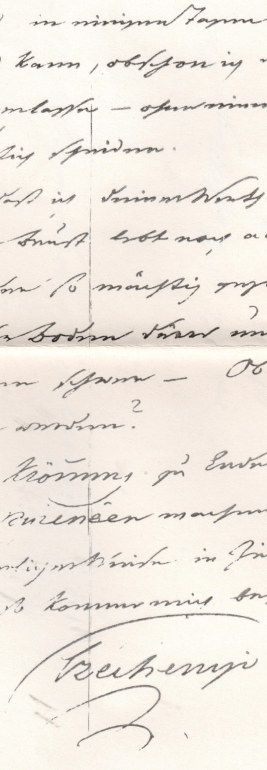
The signatories of the letter set prizes for the horse races. From 1822 onwards, the races will be held annually in Pest, open to all. Further details to appear in the newspapers.
Pferde Wettrennen Preise.[1]
Die Unterfertigten haben Preise auf Pferd-Wettläufe festgesetzt, und zwar theils für Pferde, die auf dem ganzen Continent Europa‘s geboren, theils für solche, welche in der Oesterreichischen Monarchie, theils aber solche, die nur in den ungarischen Provinzen geboren und erzogen wurden.
Diese Wettrennen werden vom Jahre 1822 angefangen, alljährlich im Monath Juny in der kön.[2] Freien Stadt Pesth abgehalten werden, und an welchen Theil zu nehmen jedermann höflichst ersuchet wird.
Die Preise sind für 1822 von jedem der Unterschriebenen Hundert k. k.[3] Dukaten in Gold.
Für das Recht sein Pferd mitrennen zu lassen, wird nichts entrichtet. Die näheren Umstände und Aufschlüsse, werden später ebenfalls durch die Zeitungen bekannt gemacht werden.
Wien den 12ten Jänner 1822.
Baron Joseph von Brudern,[a]
Ein Unbenannter,[b]
Graf Karl von Eszterházy,[c]
Ein Unbenannter,b
Graf Ladislaus Festetits,[d]
Herr Michael von Hengelmüller,[e]
Graf Stephan von Károlyi,[f]
Graf Ludwig von Károlyi,[g]
Graf Georg von Károlyi,[h]
Ein Unbenannter,b
Graf Ferdinand von Pálffy,[i]
Graf Franz von Pálffy,[j]
Graf Paul von Széchényi,
Gr. Stephan von Széchényi,
Graf Michael von Viczay Senior.[k]
[1] Széchenyi’s underlining with two lines.
[2] königlichen
[3] kaiserlich-königlicher
[a] Baron József Brudern (1774–1834), an ennobled Hungarian, was actively involved in Széchenyi’s horse-racing movement in 1822. His house (a glass-roofed Parisian bazaar) was a notable building in Pest.
[b] From the minutes of the meeting held at Széchenyi’s, the names of the unnamed persons can be ascertained: Count János Batthyány (1784–1865), Prince Antal Grassalkovich (1771–1841) and Prince Ede Lichnowsky (1789–1845).
[c] Count Károly Esterházy (1799–1856), a friend of Széchenyi, was the owner of the Szered estate in Pozsony County, and served as county governor of Tolna County (1837–1845) and then of Győr County (1845–1848).
[d] Count László Festetics (1786‒1846), Széchenyi’s cousin.
[e] Michael Hengelmüller a Viennese banker and wholesaler.
[f] Count István Károlyi (1797–1881), brother of György Károlyi, retired from his military and diplomatic career in 1821 and supported Széchenyi’s initiatives as a patron.
[g] Count Lajos Károlyi (1799–1863) was the administrator of Csongrád County (1830–1837), later the county governor of Abaúj County (1841–1845), then of Nyitra County (1845–1848).
[h] Count György Károlyi (1802–1877) was a politician who founded a political club (reunio) with Széchenyi during the 1825–27 Diet. He was a patron of the arts and a founding member of the Hungarian Society of Sciences. From 1839, he served as county governor of Csongrád County, and then as county governor of Békés County from 1842 to 1848.
[i] Count Ferdinand Pálffy (1774–1840), mining engineer, held a mining office in Vienna from 1806. He was a great lover of the theatre, and from 1807 he supported the German theatre in Vienna and later became director of the court theatre.
[j] Count Ferenc Pálffy (1780–1852), imperial-royal chamberlain, owner of Bazin in Pozsony County.
[k] Count Mihály Viczay the Elder (1756–1831), numismatist, collector of coins and antiquities.
Recommended reference:
István Széchenyi to the Hungarian Court Chancellery, Vienna, 12 January 1822. Edited and annotated by Szilvia Czinege. Published in Correspondence of István Széchenyi. Digital edition. Edited by Szilvia Czinege and Zoltán Fónagy. https://szechenyilevelezes.abtk.hu/ Abbreviation for further references: SzIL-Digit.