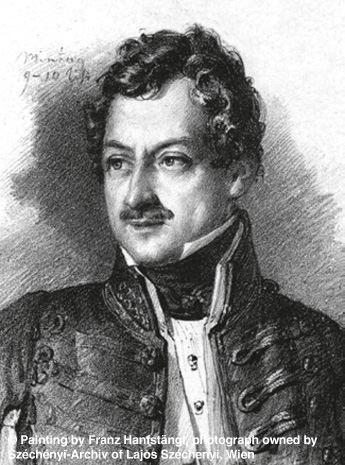

István Széchenyi grew up with his two brothers and two sisters in a loving, child-centred atmosphere for his time. The love marriage of his parents, Count Ferenc Széchényi and Countess Júlia Festetich, was a rarity in the aristocratic world. The parent-child relationship was characterised by emotional contact rather than the ceremonial aloofness common in aristocratic families. The father, Ferenc Széchényi, considered material independence, religiously-based idealism and strong patriotism to be particularly important values, and raised his children in the Hungarian spirit.
In his letters to his parents until their deaths in the early 1820s, he regularly reported about the events of his life (military service, travels, etc.). His brothers Lajos and Pál, his sisters Franciska (Mrs Miklós Count Batthyány) and Zsofia (Mrs Ferdinand Count Zichy), their spouses and children, and members of his extended family also occur in several letters, either as recipients or mentioned in the text.
In Széchenyi’s own family life, the characteristics of both the traditional patriarchal family model and modern love marriage were present. Even in his own age, he was late in starting a family: he was 44 when he married Countess Crescence Seilern. The wedding was preceded by more than a decade of platonic love; Crescence had previously been married to Count Charles Zichy. After her widowhood and the mourning period, they were married on 4 February 1836 in the church of Krisztinaváros, Buda.
The Count did not only count on his wife for social representation, but treated her as an equal intellectual partner. Crescence brought seven minor children – four boys and three girls – into the family from her previous marriage. Széchenyi was conscientious and energetic in caring for his stepchildren. He followed their upbringing and education closely, guided the military careers of the boys who joined the army, and tried to keep their finances in order. In the last years of his life, he developed a particularly intimate relationship with the second eldest Zichy son, Geyza, who essentially acted as secretary to the hermit of Döbling, who was once again active in politics as a public writer. His main paternal attention, however, was understandably focused on his own sons, Béla, born in 1837, and Ödön, born in 1839. The role of father was not an intensive presence in the lives of children in that age. Up until the collapse of 1848, Széchenyi fulfilled his parental duties primarily by carefully selecting tutors and private teachers, monitoring his sons’ physical and mental development, and occasionally making excursions into the adult world.
In the second half of the 1850s, he gradually resumed his role as father, only to make a very intensive attempt from 1857 onwards to make up for what he had failed to do since his collapse. The main ‘victim’ of his somewhat belated efforts was his first-born son Béla. The boy in his early twenties was forced to navigate between diametrically opposed paternal expectations and ‘pedagogical’ catches, and he, like a ‘good son’, bore the educational hyperactivity of his elderly father, approaching 70, with resigned patience, which was largely embodied in the letters he wrote from Döbling, containing detailed advice on behaviour and life management.