
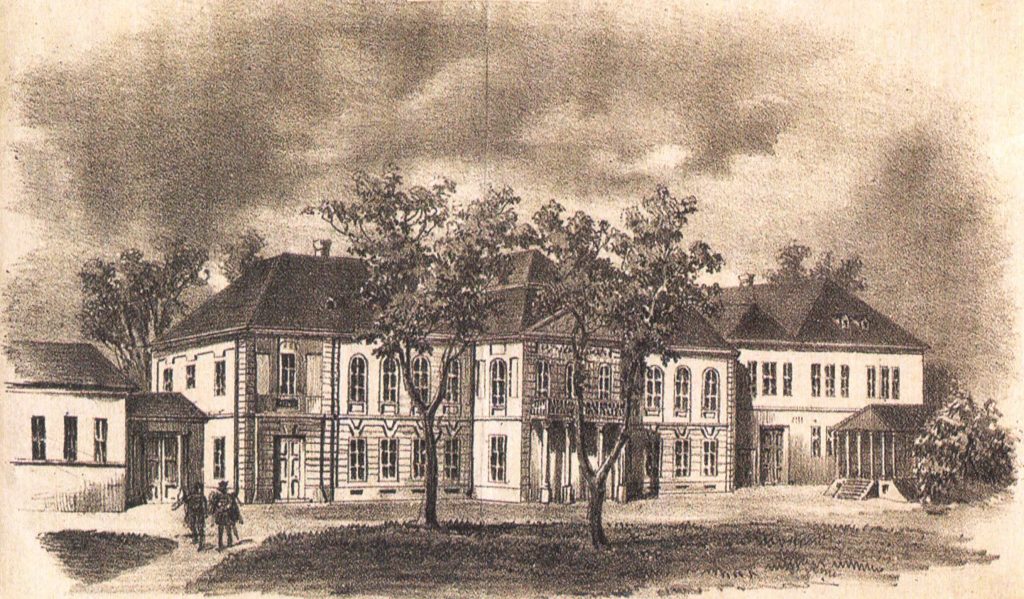
The estate

After his father divided his estates with his sons in 1814, Széchenyi had to attend to matters of his estate, too. However, the young Hussar officer was not initially concerned with the matters of his estate. His former tutor, János Lunkányi (Liebenberg), was in charge of the matters of the estate as livestock manager.
Széchenyi received his entire inheritance of some 87,000 acres in January 1821, after his father’s death.

Széchenyi was forced to rationalise his management by the debts that he inherited and accumulated himself. In this spirit, he sold the greater part of his estate to his brothers and wished to farm the remainder in a modern way. He was left with the inalienable Pölöske feudal tenure and the manor in Cenk, totalling some 30,000acres. Most of his income from his estates, which were mainly in Sopron County, came not from the serfs’ services but from the production of his farms.

Széchenyi also sought to increase the share of non-agricultural activities in his income. He invested money in various commercial and industrial enterprises in the hope of making a profit. He was a shareholder in the First Danube Steamboat Shipping Company, which, after an initial high risk, brought a handsome profit to its shareholders. He also risked his own money in the joint-stock company which built and operated The Chain Bridge in Budapest as well as in the Balaton Steamship Company. He also invested money in the nascent domestic manufacturing industry by buying shares: in the József Rolling Mill in Pest, and he also held shares in savings banks as well as Austrian and French government bonds. Seeing the potential of Pest’s rapid urbanisation, he bought property there in the 1840s.

Letters

icon-letter-2
Recipient Ferenc Pap
Place of Writing Vienna
Date of writing 1803. November 29.
Tag Hungarian language learning tobacco
gold arrow
icon-letter-2
Recipient Ferenc Széchényi
Place of Writing Győr
Date of writing 1809. May 15.
Tag horses military
gold arrow
icon-letter-1
Recipient János Liebenberg
Place of Writing Apáti
Date of writing 1814. September 2.
Tag wine
gold arrow
icon-letter-1
Recipient János Liebenberg
Place of Writing Vienna
Date of writing 1814. October 10.
Tag travel wine
gold arrow
icon-letter-3
Recipient János Liebenberg
Place of Writing Vienna
Date of writing 1814. October 12.
Tag wine money
gold arrow
icon-letter-3
Recipient János Liebenberg
Place of Writing Vienna
Date of writing 1814. October 23.
Tag wine
gold arrow
icon-letter-2
Recipient János Liebenberg
Place of Writing Vienna
Date of writing 1814. November 3.
Tag wine
gold arrow
icon-letter-2
Recipient Ferenc Széchényi
Place of Writing Novi
Date of writing 1815. April 9.
Tag military horses money travel
gold arrow
icon-letter-3
Recipient Ferenc Tibolth
Place of Writing Vienna
Date of writing 1815. June 21.
Tag estate
gold arrow
icon-letter-2
Recipient Ferenc Tibolth
Place of Writing Vienna
Date of writing 1815. June 28.
Tag estate military
gold arrow
icon-letter-1
Recipient János Liebenberg
Place of Writing Vienna
Date of writing 1815. September 9.
Tag horses wine money
gold arrow
icon-letter-3
Recipient János Liebenberg
Place of Writing Paris
Date of writing 1815. September 22.
Tag castle travel
gold arrow
icon-letter-1
Recipient Ferenc Széchényi
Place of Writing London
Date of writing 1815. October 6.
Tag learning travel money horses
gold arrow
icon-letter-2
Recipient Ferenc Széchényi
Place of Writing London
Date of writing 1815. October 15.
Tag horses money travel
gold arrow
icon-letter-3
Recipient Ferenc Széchényi
Place of Writing London
Date of writing 1815. October 21.
Tag horses travel
gold arrow
icon-letter-1
Recipient János Liebenberg
Place of Writing London
Date of writing 1815. November 3.
Tag estate
gold arrow
icon-letter-2
Recipient János Liebenberg
Place of Writing London
Date of writing 1815. November 8.
Tag castle
gold arrow
icon-letter-3
Recipient János Liebenberg
Place of Writing London
Date of writing 1815. December 1.
Tag wine horses hunt
gold arrow
icon-letter-2
Recipient János Liebenberg
Place of Writing London
Date of writing 1815. December 3.
Tag castle
gold arrow