
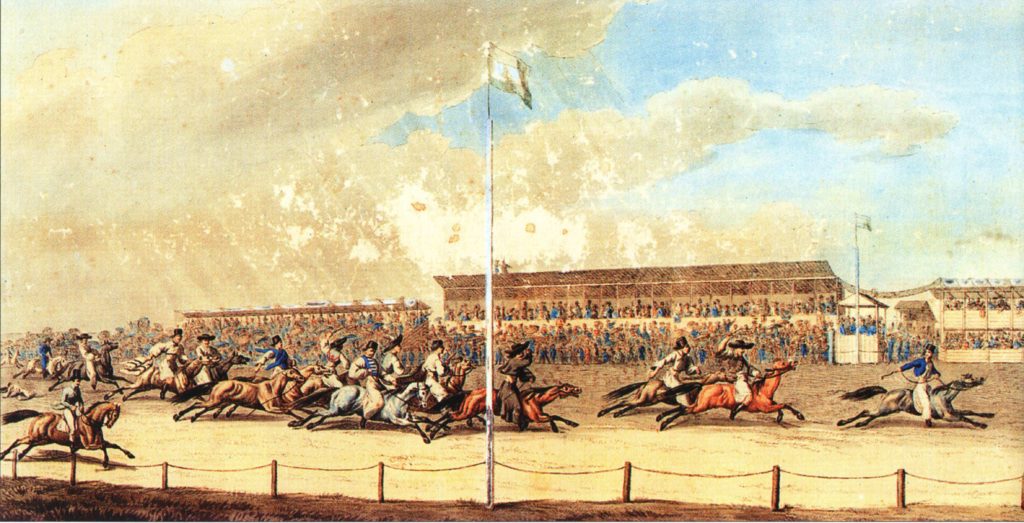
Széchenyi’s experiences in England made him aware that Hungary’s horse population left much to be desired, both in terms of quantity and quality. He saw the main reason for this underdevelopment in the fact that horse breeding in his country was only a prestige activity for the aristocracy, whereas in England it was a profitable business. He considered changing the traditional noble mentality a key issue: he wanted to use horse racing to introduce capitalism’s profit motive among the social elite, where the prestige of the gentry was even more dominant. He considered changing the traditional noble mentality a key issue.
Széchenyi did not want to help the quality problems of horse breeding based on the myth of a horse nation. By introducing horse racing he wanted to stimulate the economy, modernise social life and deepen the role of Pest-Buda as the capital city. He was a good horseman and a skilful driver: as a sportsman, he even rode in races in the early 1830s.
Széchenyi began to renew horse breeding by acquiring good breeding stock: he brought dozens of thoroughbreds to Hungary and hired English specialists for his stud farm. His example was followed by other aristocrats.
Széchenyi wanted to get the noble elite to accept the principle of profit through horse racing. He founded the first association organising horse races and drafted the racing rules. The first horse races in Pest started on 6 June 1827. In addition to the English thoroughbreds and professional jockeys of the aristocracy, peasant horses also competed. The Hungarian Economic Association, the most important agricultural lobby organisation, grew out of the Horse Breeding Association, which Széchenyi organised in 1828. The Pest Horse Society, founded in 1842 and of which Széchenyi became the first president, organised horse racing and controlled English thoroughbred breeding for a good hundred years. On the basis of the foundations established in Széchenyi’s time, Hungarian equestrian sport had many international successes in the 19th and 20th centuries.

