
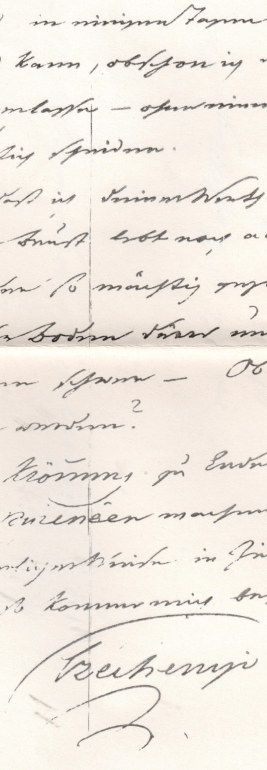
He sends the bond for 200 forints, if Lichnowsky gives him 8 forints of it, they’ll be even. He hopes to see him in Laxenburg on Sunday.
Je vous envoie ci joint l’obligation de 200 # que vous[a] avez donné a ferdinand[b] et qui m’appartienne a cet heure ci. En me rendant 8 # j’aurais donc payé les 180 que je vous dois et le 12 que je voeux bien payer a vos employés. Dans cette affaire nous voila donc quit. A ce que vous m’avez cru plus grand nigaud que je ne suis. J’espere cependant que vous ne dedaignerez pas de venir Dimanche a L’axenbourg,[c] pour que je vous montre que le bon Dieu m’a éclairci assez de ses lumières pour que je ne souffre pas qu’on écrive des notes semblables a la vôtre.[d]
[a] His brother-in-law Count Ferdinand Zichy (1783‒1869) general.
[b] From 1814, Prince Eduard von Lichnowsky (1789–1845) managed his estate (Gräz bei Troppau) and was the first in Germany to breed Merino sheep. He was also a writer and historian, his main work Geschichte des Hauses Habsburg, was published in 8 volumes between 1836 and 1844.
[c] Laxenburg, an Austrian town, today in the state of Lower Austria.
[d] The letter is a reply to Prince Lichnowsky’s letter of 1 May 1817.
Recommended reference:
István Széchenyi to Eduard von Lichnowsky, Vienna, 2 May 1817. Edited and annotated by Szilvia Czinege. Published in Correspondence of István Széchenyi. Digital edition. Edited by Szilvia Czinege and Zoltán Fónagy. https://szechenyilevelezes.abtk.hu/ Abbreviation for further references: SzIL-Digit.