
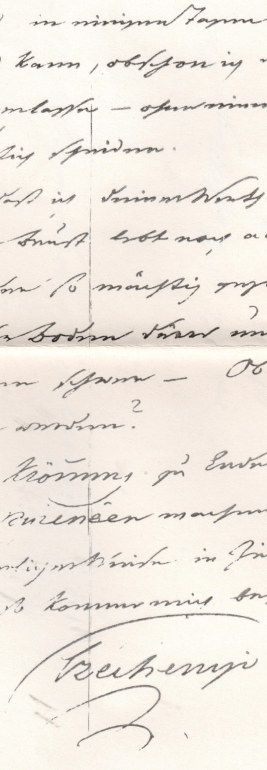
He forgot to say that Kiss does not get food from them, which he will probably whine about. The capital of 11.150 forints he invested with Széchenyi is due in May. More about this in person. If he sends Pitner for the wines, he can bring 450-500 empty bottles with him, because he wants to bottle the content of the Madeira barrel. The question is whether they have that many empty bottles.
Wien d. 21ten Jäner 1821
Liebster Liebenberg!
Ich habe vergessen Ihnen neulich zu sagen, daß Kiss,[a] nachdem er von uns dreӱ Brüdern jährlich 1500 fl[1] c. m.[2] erhält, hinführo keine Victualien erhalten wird.[b] Er wird wahrscheinlich lamentiren, was ich geschehen lassen will, denn er ist einer von den ewig Unzufriedenen. Das Capital von 11,150 fl.1 welches er beӱ mir angelegt hat, wird im nächsten Maӱ fällig. Da wir es schwer auszahlen könnten, und er sub aliquibus conditionibus[3] außerordentlich gern beӱ mir liesse, so wollen wir es behalten. Das Weitere mündlich in Zinkendorf. Erinnern Sie mich daran. Sobald ich Sie besuche, werde ich wünschen eine generale Berechnung der Einkünfte, und Ausgaben des Jahrs 1820 beӱ Ihnen zu finden.[4]
Wenn Sie den Pitner[c] hieher senden, um Grafen Merey’s[d] Weine abzuziehen, könnte er 450 bis 500 leere Bouteillen mitbringen; da ich das Faß Madeira auch abziehen will lassen, um daß wir, wenn das Haus auf der Landstraße verkauft werden sollte, mit der Transportierung eines Faßes in keine Verlegenheit kommen mögen. Nun ist die Frage noch zu beantworten, ob wir so viele leere Bouteillen haben und wenn der Binder hieher kommen wird? —
Schreiben Sie mir und leben Sie wohl
Széchényi
Diesen Brief überbringt der Herr Abeless von Oedenburg, verkaufen Sie wie Sie können und wie Sie wollen.
[1] florins
[2] Conventionsmünzen
[3] Latin: under certain conditions.
[4] The first part is in Antal Pigay’s handwriting, followed by Széchenyi’s. (Note by Gyula Viszota on the copy.)
[a] József Kiss, doctor to Ferenc Széchényi.
[b] In his reply written on 27 January (MNL OL P 626–1.–1821.), Liebenberg asks Széchenyi not to sign another bond for Doctor Kiss József, because the interest on the 8,000 forints borrowed from him is 12%, i.e. 960 forints per year, and he can be satisfied with that. The amount, including unpaid interest, has risen to 11,150 forints, so he is seeking to have it paid off as soon as possible.
[c] He was likely an employee of Széchenyi who was responsible for the handling and transportation of wines.
[d] Probably a typo, instead of Mercy. Between 1820 and 1830, Széchenyi’s letters to János Liebenberg have survived only in copies, mostly in the hand of István Darvas. Gyula Viszota probably compared these with the original manuscripts and sometimes made corrections in pencil, as he likely did with this name (Ms 4229/252 f. 3), correcting Merey to Mercy. Given the content of the letter mentioned in note f), it is more likely to be about Count Mercy.
Andreas Florimond Count Mercy d’Argenteau (1771–1840) was an Austrian diplomat, counsellor at the State Secret Chancellery, confidant of Metternich. Széchenyi also sold him wine in October 1816 and 1817. See the letters of 6-7 October 1816 and 24 October 1817 and 19 May 1823.
Recommended reference:
István Széchenyi to János Liebenberg, Vienna, 21 January 1821. Edited and annotated by Szilvia Czinege. Published in Correspondence of István Széchenyi. Digital edition. Edited by Szilvia Czinege and Zoltán Fónagy. https://szechenyilevelezes.abtk.hu/ Abbreviation for further references: SzIL-Digit.