
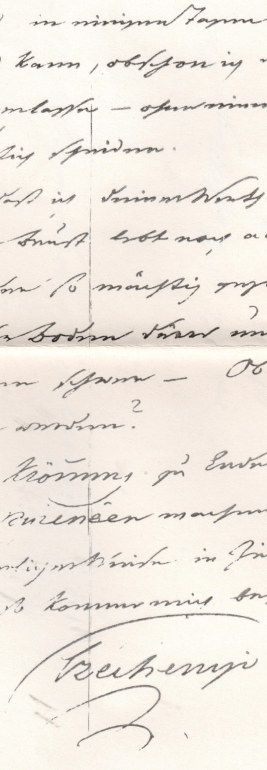
Magyar fordítását közli: Kovács–Körmendy–Mázi–Oplatka 194–195.
A különösen száraz, esőtlen év miatt Magyarországon és Törökországban veszélyben vannak a gőzhajózási tervek. A három hajó – az I. Ferenc, az Argo és a Pannónia – gyakran fut homokzátonyra. Ez aggasztja Széchenyit, hiszen a közvélemény még nem áll maradéktalanul vállalkozása pártján. Úgy gondolja, hogy ez az év még hasznosnak is bizonyulhat, hiszen az alacsony vízállásnak köszönhetően jól haladt a munka. A következő év sikerességét sem szeretné a véletlenre hagyni, ezért a következő kérdésekre vár válaszokat Wattól:
1. A Duna Bécs és Fekete-tenger közötti szakaszán az eddig mért legalacsonyabb értéknél majdnem 46 centiméterrel alacsonyabb a vízállás, de az örvények és sziklák között elférne még egy rövid hajó, amelynek 61 centiméternél nem nagyobb a merülése. Meg lehetne-e építeni ezt az utasszállító hajót vörösfenyőből, úgy, hogy az elbírja a szükséges motort és 24 órára elég üzemanyagot is? Képes lenne-e ez a hajó a Pest és Pozsony közötti áramlathoz hasonló ellen haladni, ahogyan arra a Pannónia képes?
2. Milyen erős gőzgépekre lenne ehhez szükség, mennyibe kerülnének, és mikor lehetne őket Londonból szállítani?
3. Ha a hajó oldalsó ablakok helyett csak tetőablakokkal és megfelelő vitorlázattal lenne felszerelve, nem lehetne-e akár Konstantinápolyig lehajózni vele, és időnként a Földközi-tengeren is használni?
4. Hány ágy férne el rajta szolgáknak és uraknak a hajó legénységén kívül?
5. Tudna-e Watt terveket küldeni a hajóról, amely alapján azt meg lehetne építeni Bécsben?
6. Ha a hajó nem csak utasokat szállítana, lehetne-e azt vonóhajóként használni, és van-e olyan szerkezet, ami ebben anélkül segítene, hogy kárt tegyen a hajó szerkezetében? Ez fontos, hiszen vannak olyan szakaszok, ahol olyan erős az áramlat, hogy mindig szükség lenne szárazföldi segítségre.
7. Nem építhető-e meg úgy a hajó, hogy a saját motorjával fel tudja magát húzni egy adott pontig kötél vagy lánc segítségével? Ha igen, mekkora távolságot tudna így legfeljebb megtenni?
Széchenyi kéri Wattól, hogy válaszait a lehető leggyorsabban Bécsbe, Puthon bárónak küldje. Tartozása lerovásaként egy (nehézségek árán felkutatott) jó Tokajit küld majd – apránként, hiszen annak csak a tavasz kezdetén szabad utaznia.
My dear Sir,[a]
The extraordinary dryness of this year, which never known before continues from the earlier part of the spring, since when there was hardly a good day’s rain in whole Hungary, and none whatsoever in Turkey, puts our steam – navigation in great jeopardy. Our three boats, Francis I, Argo and Pannonia are as often and as long on sandbanks, as in sailing. It is a sad work altogether, as our public spirit is not yet settled firmly enough to get quietly over “contre-tems” of this nature. Great many lost already their spirits, while I not only kept[1] mine, but got with energy, gun-powder and pretty fair success good hold of some of those rocks, which intercept the passage of boats in this part of the Danube, where I spent the last summer, still now reside and shall remain as long as the weather permits it. I believe indeed, that this extraordinary year, which I and some of us did not waste away idly, will, taking every thing in consideration, not only not be injurious to the ultimate full success of our undertaking, but will prove very useful in the end, as there is not a stone not a sandbank, which we did not contrive to put upon our charts, and there are great many of the most alarming rocks already got out of the way, so that we may pretty safely anticipate better luck and success for next year. But I should not like to depend upon chances and be bound by casualities, and shall therefore avail myself of your kindness, which you show’d me in all occasions, to ask you the favor of some informations.
There is from Vienna to the black sea in this moment – where the water is more than 1 ½ feet lower than ever known before — over all rapids and rocks yet a free passage for a not very long boat, and not drawing more than 2 feet english.[b]
I will put to you now some questions
1o Can a boat be built of larch wood calculated mainly for passengers and carrying sufficiently strong engines and fuel for 24[2] hours, not drawing more than 2 feet english, and which would be strong enough to prevail against a current as strong as between Pest and Presburg, where Pannonia gets up without much struggle and without being in trouble, and you may guess there fore in some measure what strength would be required.
2o What power of engines do you think best calculated to obtain the wished for results; what were their price and when could they be delivered in London from the date of the order?
3o Could this boat, if she had no side-windows but only sky-light, and were properly masted and rigged, not serve to procede to Constantinople on the black sea with safety also, and be used occasionally in the Mediterranean?
4o For how many beds could she be fitted up comfortably for masters and servants, besides the captain and crew?
5o Would you find the minute drawings for the eventual building of the boat, whereupon she might be built at Vienna?
6o Could the boat, in case she did not pay by carrying only passengers, not serve also as a tow-boat, and is there not some contrivance, that she may effect this without being too much shaken in her frame, a point which requires due consideration, as there are some passages, where the current is so strong that she never could get up over them by her own strength only, but would always require some assistance by land.
7o Could it not be effected without causing too much complication, that the boat might wind[3] up herself by the force of her own engines, by a rope or chain to a fixed point? And what would be the utmost distance, to which this could be effected?
And these are the informations which you’ll be so kind as to give me without delay.
I beg your pardon that I explain myself in so bad english and that I give you the trouble to make it out.
Send your letter to Vienna the care of Baron J. B. Puthon.[c]
I found – though with no little difficulty — some good Tokay to pay off my debt, and shall send it on now by and by, as Tokay must travel in the earliest part of spring else it is sure to spoil.
Adieu my dear Sir, and believe me
Yours very faithfully
Orsova October, 1834[d]
[1] Utólag rendezett szórendű szövegrész.
[2] Törölve egy szó.
[3] Utólag beszúrva.
[a] James Watt (1769–1848) angol mérnök, a Boulton & Watt cég egyik vezetője.
[b] Egy angol láb 30,5 cm.
[c] Johann Baptist von Puthon báró (1776–1839) bécsi bankár, a Duna Gőzhajózási Társaság igazgatója.
[d] A nap nem került bele a másolati könyvbe, de tekintve, hogy szinte egész hónapban nem tartózkodott Orsován, csak október 1. és 3., valamint október 28 és 31. között, így a levél ezen napok egyikén íródott.
Ajánlott hivatkozás:
Széchenyi István James Wattnak, Orsova, 1834. október S. a. r. és jegyz.: Czinege Szilvia. Közli: Széchenyi István levelezése. Digitális kiadás. Szerk. Czinege Szilvia–Fónagy Zoltán. https://szechenyilevelezes.abtk.hu/ További hivatkozásnál rövidítve: SzIL–Digit.